Column · @serviceswebsiteguide196
Electrician Website Design That Generates Leads in 2026
A good electrician website does not need to impress other designers. It needs to turn urgent intent into contact. When someone smells a burning outlet, loses power in half the house, or needs a panel upgrade quote before closing on a property, they are not browsing for inspiration. They are looking for signs of competence, speed, legitimacy, and a clear next step.
That is the real standard for electrician website design in 2026. Not whether the homepage looks trendy. Not whether the animation feels modern. What matters is whether the site earns read more here trust fast enough to produce calls, form submissions, and booked jobs.
I have seen the same pattern across home service companies. A contractor spends time and money on a site, gets some traffic, then wonders why the phone is still quiet. The problem is usually not a single flaw. It is a chain of friction points. The page loads slowly on a phone. The service area is vague. The contact path is buried. The Google Business Profile and the website say slightly different things. Reviews exist, but the site does not use them well. Search engines can crawl only part of the content, or the pages that should rank never become strong enough to compete locally.
For electricians, the stakes are even higher because the work often sits at the intersection of urgency and trust. People are inviting someone into their home, sometimes the same day, to handle a system that can be dangerous when done poorly. Your website has to answer the unspoken question quickly: “Can I trust this company to solve my problem without wasting my time?”

What a lead-generating electrician site actually does
The best contractor lead generation website is not just informative. It removes hesitation. It gives the visitor confidence that they found a real local business, that the company works in their area, and that reaching out will be simple.
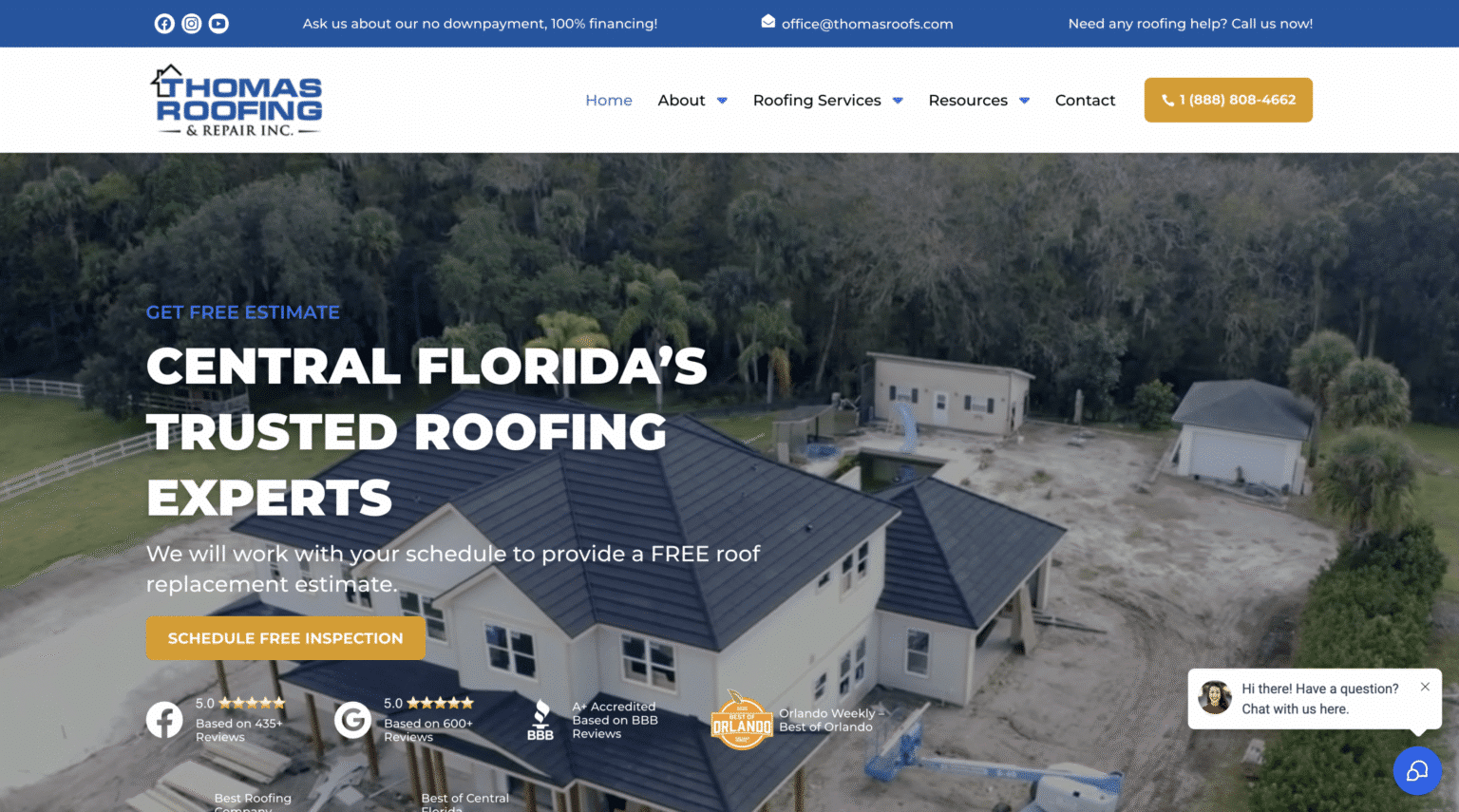
That starts with clarity. If you are an electrical contractor serving a metro area from one central office, the website should reflect that reality cleanly. The service area should be specific. If your Google Business Profile is set up as a service-area business, your website should reinforce the same geography and same business identity. Google’s own guidance for service-area businesses is practical here: businesses can operate from one central location, define the places they serve, and, if they do not meet customers at their address, hide the address and present a phone number or website that represents that location. Too many contractor sites blur this point and create confusion.
Clarity also means saying what you do in plain language. Residential electrical repair, panel upgrades, EV charger installation, lighting, troubleshooting, generator-related electrical work if that applies, and emergency service if you truly offer it. Homeowners should not have to decode branding copy to figure out whether you can help.
There is a larger principle underneath this. A contractor website that generates leads is built around intent, not vanity. It anticipates questions the customer already has in mind. Do you serve my area? Can I call now? Are you established? Can I trust your reviews? Is your website easy to use on my phone? Can I get to the contact page in one tap? Those are practical concerns, and a lead-focused website answers them before they become objections.
Electrician website design starts with local search reality
Many owners ask how to get more leads for contractors as if lead generation begins with advertising. Sometimes it does. But for local service businesses, your organic presence and your Google Business Profile often carry a bigger share of day-to-day opportunity than people expect.
A verified Google Business Profile helps customers find a business on Search and Maps and gives them quick access to hours, phone number, website, booking links, and other business information. That matters because many prospects meet your company there before they ever land on your homepage. If the profile is strong but the website is weak, you lose momentum. If the website is solid but the profile is neglected, you lose visibility and trust.
For electricians, the website and profile should work as one system. The profile gets you discovered. The website closes the gap between discovery and action.
This is where local SEO for home service businesses often goes wrong. Companies build one generic “Service Areas” page with a long city list stuffed into the footer. That may feel efficient, but it does not do much for the homeowner who wants evidence that you regularly work in their area. It also does not give search engines much context. Google’s guidance says service areas should be accurate and specific, and service-area businesses can define them by cities, ZIP codes, or other places served. Your website should follow that same logic in a way that feels useful, not robotic.
If you serve several towns or neighborhoods, create content that reflects the actual service footprint. The point is not to manufacture dozens of thin pages. The point is to align your site with the way real customers search. Someone in one suburb may search for an electrician near them very differently from someone in the next town over. Your site should help bridge that local intent.
The homepage should answer urgent questions in seconds
On an electrician’s homepage, the first screen matters more than most business owners think. Not because users never scroll, but because first impressions set the tone for every next action.
A homepage that generates leads usually does a few things immediately. It identifies the company clearly, confirms the service category, shows the areas served, and presents a direct way to call or request service. It also signals legitimacy through details that feel concrete rather than promotional. Real service descriptions. Real hours if published. A working phone number. A simple path to contact. If reviews or testimonials are included, they should support the trust story, not overwhelm the page.
This is one place where electrician website design overlaps with plumbing website design, foundation repair website design, water damage restoration website design, kitchen and bath remodeling website design, solar company website design, and fence contractor website design. The trades differ, but the trust equation is similar. Visitors want local relevance, proof of real operations, and a low-friction way to take the next step. The difference is that electrical work often has a sharper urgency curve than remodeling and a stronger safety concern than some exterior trades, so the language and page structure should reflect that.
Design choices should support that urgency rather than distract from it. Heavy hero videos, oversized sliders, or intrusive popups often get in the way. Google’s page experience guidance is useful here. Search performance is influenced by mobile friendliness, HTTPS, and avoiding intrusive interstitials that interfere with the main content. Even if a popup captures a few extra email addresses, it can cost you trust and usability where you need them most, on a small mobile screen during a time-sensitive search.
Speed is not cosmetic, it is commercial
Most electrician leads happen on mobile devices, often in moments of practical need. That makes performance a business issue, not just a developer metric.
Google recommends good Core Web Vitals for search success, with LCP under 2.5 seconds, INP under 200 milliseconds, and CLS under 0.1. Those numbers are not abstract for a service business. A slow-loading hero image can delay the moment when the phone number appears. Poor interaction responsiveness can make a call button feel broken. Layout shift can cause a visitor to tap the wrong thing or lose their place just as they decide to contact you.
I have watched contractors chase lead problems by rewriting copy or redesigning logos while the real issue sat in plain sight: the page simply felt slow and clumsy on a phone. Users do not describe it in performance terms. They do not say your LCP is weak. They just leave.
A faster site usually feels more trustworthy. It looks maintained. It respects the user’s time. For urgent service categories, that matters a great deal. If your site struggles on mobile, every other improvement is working uphill.
Service pages should match how customers actually search
Electricians often organize their websites around internal categories that make sense to the company but not always to the homeowner. A customer may not know whether they need “diagnostics,” “branch circuit correction,” or “service upgrade consultation.” They know they have flickering lights, a tripping breaker, an old panel, or a charger they want installed.
The strongest service pages bridge professional language and homeowner language. They explain the service clearly, name the problem types it addresses, and make it easy to request help. They should also reinforce service area relevance where appropriate, especially when local intent is part of the search.
That does not mean stuffing pages with city names. It means writing with enough specificity that both the user and search engines understand what the page is about. If you have a page for panel upgrades, it should actually speak to panel upgrades. If you have a page for EV charger installation, it should focus there. Thin catch-all pages tend to underperform because they do not resolve intent cleanly.
A site that is trying to become a true contractor website that generates leads usually benefits more from stronger core pages than from a larger number of weak pages. Depth beats volume when the content reflects real services and real markets.
Google Business Profile and the website have to agree
There is no value in treating your website and your Google Business Profile for contractors as separate marketing projects. Customers compare them implicitly. Search engines do too.
If your profile presents one service area pattern, one business name, and one contact method, your site should not muddy the picture. If you hide your street address in the profile because you do not meet customers there, your site should still present the business in a way that reflects a legitimate local operation without forcing an address display that creates confusion. If your hours are listed in the profile, your website should not suggest something contradictory.
This alignment sounds simple, but it gets missed often. A lead-generation system breaks down when one property says one thing and another says something else. Consistency lowers doubt.
There is also a practical conversion angle. A verified Business Profile can send visitors directly to your website. When those users arrive, they should feel immediate continuity. Same business identity, same markets served, same phone number, same promise of help. Any mismatch introduces friction at the exact moment you need confidence.
Reviews matter, but the way you collect and use them matters too
For most electrical contractors, reviews are one of the strongest trust assets available. They are also one of the easiest areas to mishandle.
Google’s review guidance is clear that reviews must reflect genuine experiences. Incentives for reviews are prohibited. Businesses can ask customers to leave reviews, share a Google review link or QR code, and should respond promptly. That gives you a simple, defensible process. Do solid work, ask consistently, make the review path easy, and respond like a professional.
The website’s role is not to fabricate social proof or cherry-pick without context. Its role is to support the same trust story already visible in Google. A homepage can reference review strength. Service pages can include short snippets if they are authentic and relevant. What matters is that the reviews feel real and current, not staged.
A company with twenty honest reviews and thoughtful responses often creates more confidence than a company with a larger count and no signs of engagement. People read tone. They notice whether a business sounds defensive, careless, or attentive. For home services, especially inside occupied homes, those signals carry weight.
Technical basics decide whether your pages can compete
Some contractor websites fail for reasons that never appear on the surface. The pages look fine, but search engines cannot access them cleanly, or important content sits in a format that contributes little to discoverability.
Google’s technical guidance is straightforward: pages must be publicly accessible and not blocked in order to be indexed. That sounds obvious, yet it catches more businesses than you would think. A redesigned site launches with noindex settings left on. A location page is hidden behind scripts that are not rendered well. Important content exists only in images. None of this is dramatic, but all of it can suppress local performance.
Structured data is another area where electricians can gain clarity without gimmicks. Google’s local business structured data documentation allows sites to mark up details like hours, departments, address, geographic information, and phone. This does not guarantee rankings, but it helps Google understand the business more accurately. For local service companies, clear understanding is rarely a bad thing.
If I were reviewing an electrician website for lead generation, I would want these technical points checked early, because they affect every marketing effort layered on top.
- pages are publicly accessible and not blocked from indexing
- the site works well on mobile devices
- HTTPS is in place
- intrusive interstitials do not interfere with the main content
- local business details are presented clearly and, where appropriate, marked up for search engines
None of that feels glamorous, but these are the conditions under which your stronger content and local signals can actually do their job.
Call handling is part of website performance, whether owners like it or not
This is the part many companies skip. They judge the website by form fills and forget that much of electrician demand comes in by phone. If the website produces calls but the calls are not answered or returned quickly, the site gets blamed for an operations problem.
Google’s guidance around local service leads makes an important point: missed-call handling matters, and replying quickly to leads is supported directly in Google Ads lead workflows. That reflects a larger truth. Speed to response affects close rates. A good website creates opportunity, but your office process has to catch it.
I have seen businesses redesign perfectly decent sites when the deeper problem was simple: calls were missed during lunch, after-hours voicemails were returned the next day, or the contact form went to an inbox nobody checked closely. The result looked like weak marketing, but it was really weak follow-through.
A lead-generation website should make contact easy, but the business must make contact meaningful. That includes clear call routing, prompt callbacks, and a process for handling the people who reach out when your crew is in the field.
The pages that often produce the best results
Electricians do not need a huge site to compete well locally. They need the right pages, built with enough substance to earn trust and align with search intent.
A compact but serious site usually benefits from a homepage, strong service pages, a clearly useful contact page, and service area content that reflects real geography. Review signals and business details should appear where they help, not as clutter. If the company operates from a central office and serves multiple surrounding communities, that should be communicated consistently across the site and the Business Profile.
Here is where judgment matters. A smaller market may not need the same page depth as a dense metro. A company focused on a handful of high-value services may perform better with tighter messaging than a broad catalog. Not every electrical contractor needs the same content architecture. The principle is relevance, not bloat.
What electricians can borrow from other contractor niches
There is a lot of overlap between electrician website design and the patterns that work in other trade websites. A well-built plumbing website design often handles urgency well. A solid water damage restoration website design understands how to reduce friction under pressure. Kitchen and bath remodeling website design is usually stronger at portfolio presentation and trust building over a longer buying cycle. Foundation repair website design often does a good job addressing skepticism with clear explanations. Solar company website design tends to focus heavily on education, while fence contractor website design often leans into service-area specificity.
The lesson is not to copy another trade’s style. It is to understand which conversion behaviors transfer. Urgent categories need speed and immediate contact. Trust-sensitive categories need credibility and clarity. Considered-purchase categories need stronger explanation. Electrical contractors often sit in the middle, with some jobs acting like emergencies and others behaving more like planned upgrades.
That is why a one-size-fits-all contractor website rarely produces the best lead flow. The site should reflect how your actual customers decide.

A practical standard for 2026
If an electrician asked me what “good” looks like now, I would not start with aesthetics. I would start with whether the site supports the real path from search to booked work.
- the business is easy to find through a verified Google Business Profile and a website that supports it
- service areas are accurate, specific, and consistent across the profile and the site
- pages load well on mobile and meet healthy page experience expectations
- contact paths are obvious, simple, and matched by fast response handling
- the site is technically accessible to search engines and clearly communicates local business details
That is how to get more leads for contractors without relying on guesswork. You make the business easier to discover, easier to trust, and easier to contact.
A lot of websites fail because they try to look like marketing. The better electrician sites look like dependable businesses. They are clear. They are fast. They feel local. They remove uncertainty. And they turn moments of intent into actual conversations, which is the only metric that matters if your goal is lead generation.